

Five percent of the people you will encounter have organized their character around the exploitation of others. They cannot be reasoned toward fairness, appealed to through conscience, or reformed through relationship. The normal tools of moral engagement do not work on them. What follows is how to identify them and what to do when you have.
What Distinguishes Them
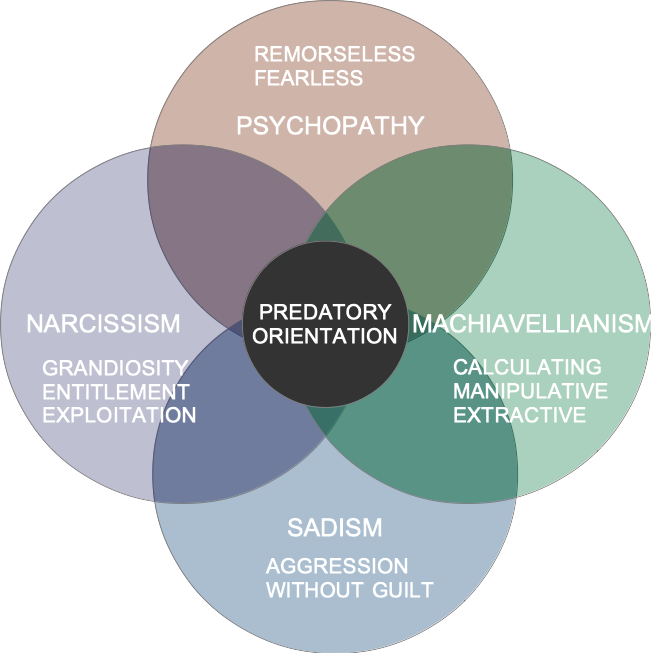
The clinical language for these people is psychopaths, narcissists, Machiavellians, and sadists. What MRI research now confirms is structural: psychopathy is associated with approximately 18% reduced amygdala volume, the brain region governing fear and emotional response, and reduced gray matter in the prefrontal cortex regions that govern moral decision-making. The anterior cingulate cortex, the primary hub for affective empathy, shows measurable physical reduction across all three Dark Triad profiles.
The critical finding is this: they retain cognitive empathy, the ability to read exactly what you feel, while the capacity to feel anything about what they find is physiologically absent. They can identify your vulnerability with precision and experience nothing. The conscience you would appeal to has no functional neurological substrate. They are, in the language the research supports, physically incapable of caring what their actions cost you. They look like you, they may talk like you, and they certainly display as feeling like you. But in all the ways that matter most, they might as well be aliens from another world bent on your submission and destruction.
Every attempt to engage on moral terms gives them additional material to use against you. They have more options than you do, because they are not constrained by the scruples that narrow your menu.
• • •
The Research
Clinical and personality psychology converge on a figure of one to five percent of the adult population displaying dark personality traits at a level that constitutes predatory orientation rather than mere self-interest. This range covers antisocial personality disorder, narcissistic personality disorder, and subclinical psychopathy, as well as those who score high on all three Dark Triad dimensions simultaneously. Paulhus and Williams, whose 2002 paper introduced the Dark Triad framework into mainstream personality research, documented this convergence across general adult populations. The five percent figure used in this framework represents the upper bound of that range, the more conservative choice for a framework governing relationship trust.
The five percent figure describes the base rate across the general population, not the rate of encounter in competitive, high-stakes environments. The Genuinely Malicious are predatory by orientation and actively seek positions of authority, institutional leverage, and concentrated power. Babiak, Neumann, and Hare, in a 2010 study of corporate managers, found psychopathy prevalence at approximately four percent in that population, four times the general rate. A man operating in corporate leadership, institutional administration, or politics will encounter this type at rates that substantially exceed the baseline. In those environments, five percent is a floor.
The numbers tell you how many. The signs below tell you who.
• • •
The Deepest Wound
The costliest feature of this encounter is epistemological. When someone who presented as trustworthy reveals themselves as predatory, the instrument used to judge trustworthiness is called into grave doubt. Ordinary betrayal implicates a person. This implicates the judgment. The question that follows is not “How could they do that?” It is “How could I not have seen it?”
That question, left unanswered, becomes the mechanism by which a man closes himself permanently. He cannot extend genuine trust again because he cannot trust his own perception of when trust is warranted. The Genuinely Malicious person inflicts two injuries in sequence: the specific harm, and then the doubt that prevents recovery from all subsequent relationships. The second injury does the lasting structural damage, and it tends to go unnamed because most men lack a framework for identifying it.
Naming it accurately is the precondition for recovering from it without losing the capacity to trust your own perception. The instrument was operating against a type it was not built to detect, because it was built by a person who assumes the basic moral grammar is shared. With this type, it is not. The encounter reveals the limit of the instrument, not a flaw in its construction. That is the cost of being formed in a world where five percent of the people you encounter are not.
• • •
Six Identifying Signs
The distinguishing feature is precision that precedes intimacy. They know things about you that you have not yet told them, because they have become masters at probing peoples’ drives, needs and weaknesses. Their generosity arrives before you asked for it. Everything they give is inventory for later deployment.
1. Uncanny accuracy before disclosure. They identify your specific emotional vulnerabilities, insecurities, or unmet needs with accuracy that exceeds what you have shared. You feel understood before you have disclosed. That feeling is the first warning, not a sign of connection. The Genuinely Malicious person reads people the way a diagnostician reads symptoms: with precision, and for a purpose.
2. Gifts that match too specifically. What they offer, in terms of support, loyalty, and validation, matches your needs with a specificity that feels uncanny rather than organic. The Actively Selfish person gives what is convenient to give. The Genuinely Malicious person gives what you specifically need, because the gift is a weapon being positioned for deployment use. The more precisely calibrated the generosity, the more carefully it should be examined.
3. Access is always deployed. Information shared in confidence reappears. In altered form, at a strategic moment, through a third party. Nothing is received and simply held. Everything enters an operational inventory. You will not always be able to trace how the information traveled, because the path is managed. What you will observe, over time, is that nothing you shared remained inert.
4. Boundary enforcement produces escalation, not withdrawal. Attempts to establish distance, reduce access, or enforce a boundary produce a response disproportionate to the action. Where the Inert person would feel hurt and the Actively Selfish person would lose interest, the Genuinely Malicious person escalates: injury is performed, third parties are recruited, institutional mechanisms are engaged. The response is not grief. It is punishment. This asymmetry is one of the most reliable diagnostics available, because it reveals the relational logic underneath the surface presentation.
5. Support vanishes completely, without taper. When their utility for you has ended, or when you have ceased to be useful to them, support does not taper. It vanishes, completely and without explanation, as though the relationship never existed. The Actively Selfish person drifts away as the arrangement loses its value. The Genuinely Malicious person disappears or turns. The absence of any transitional behavior, any acknowledgment that a relationship existed, is itself a sign: it was never a relationship. It was an operation.
6. The pattern holds across every significant relationship. Investigation of their history reveals the identical sequence across professional, personal, and institutional contexts. False presentation of self, cultivation of access, extraction or exploitation, then discard or destruction. The pattern does not vary because it is not responsive to the other person. It is a method. Most people have a few difficult relationships in their history. The Genuinely Malicious person has the same relationship with everyone, and the sequence is always the same.
• • •
The Engagement Protocol
The normal tools of moral engagement do not apply to this type. This is a specific instruction about a specific type, not a general posture toward people.
You cannot appeal to their conscience because the conscience has been effectively disabled. You cannot reason them toward fairness because fairness is not among their operating values. You cannot reform them through the relationship because the relationship is the vehicle of extraction, not a context in which reformation becomes possible. Every attempt to engage on moral terms, to appeal to what you shared, to invoke what was promised, to ask for an honest accounting, gives them additional surface area to work with. They are more strategically agile than you in this exchange because they are not constrained by the moral scruples that eliminate options from your menu.
The correct response, upon accurate identification, is complete disengagement. Not a confrontation. Not a speech about what they have done. Not a negotiated exit that gives them room to manage the terms. Simply the removal of access, executed without ceremony and without the expectation of acknowledgment.
The Genuinely Malicious person does not deserve your explanation. He deserves your absence.
Accurate identification is the precondition. The signs above require time and pattern recognition; a single incident matching one of them does not constitute identification. The pattern across multiple signs, sustained over time, is what does. Acting on premature identification is its own error, and it is one the Genuinely Malicious person will use. In institutional contexts, where the person holds authority or is embedded in structures you cannot immediately exit, the goal remains the same: minimize access, minimize disclosure, do not engage on moral terms. The mechanism of exit may need to be deliberate rather than immediate.
What the encounter with this type does produce, if it is processed through an accurate framework rather than absorbed as a verdict on one’s own judgment, is a more finely calibrated instrument. The man who has identified this type accurately, named the wound correctly, and disengaged cleanly is not closed. He is precise.
• • •
The Research Behind the Five Percent
The percentage assigned to this tier draws on two converging lines of evidence. Clinically, antisocial personality disorder affects approximately one to four percent of the general population, with higher rates among men. Narcissistic personality disorder affects roughly one to six percent. Subclinical psychopathy, meaning individuals who display psychopathic traits without meeting full diagnostic criteria, is estimated at approximately one percent at the clinical threshold. These categories overlap substantially.
The Dark Triad framework, introduced by Paulhus and Williams in 2002, measures narcissism, Machiavellianism, and psychopathy as continuous dimensions in non-clinical populations. In general adult samples, roughly one to five percent score high on all three simultaneously. The framework uses the upper bound of that range, five percent, because this is a tool for governing trust rather than diagnosing pathology. When the stakes of underestimating are high, the conservative choice is to set the threshold higher.
The one-to-five percent range is well-supported across multiple instruments, populations, and research traditions spanning more than forty years. The exact number is an estimate. The type is not.
• • •
The next installment covers the Actively Selfish, approximately fifteen percent of the people you will encounter. They are not predatory in the way the Genuinely Malicious are. The harm they cause is instrumental rather than constitutive. But under pressure, when winning requires your removal, the damage they produce is indistinguishable from what this tier inflicts. The distinction matters for how you engage them. Their difference from the Genuinely Malicious governs your strategy, not your exposure.
• • •
The posts in this series originate in research performed for, but ultimately excluded from, The Book of the Nobleman. Available at amazon.com/dp/B0H2D2ZCNY