

• • •
Most men navigate their social landscape without a governing framework. They extend trust by instinct and calibrate their disclosures according to the ambient pressure of the moment. When the arrangement works, they attribute it to good judgment. When it fails, when the person they trusted uses the access they granted, when loyalty runs in one direction until the cost of reciprocating arrives, they call it bad luck rather than bad classificatio
Bad luck is rarely the diagnosis. Misclassification almost always is.
Men of formed character cannot relate to every person identically, as though moral formation were irrelevant to the terms of engagement. It is not irrelevant. Character is not uniformly distributed across the human landscape, and the man who has spent years deliberately constructing his own knows that most people have not done this work, some have chosen the opposite, and a very few have arrived where he is trying to go. These are not the same, and treating them as the same fails the most basic test of accurate moral perception.
• • •
Three Obligations, Three Domains
A workable framework for human engagement begins by separating three things that most men conflate: decency, trust, and access.
Decency is owed to everyone by virtue of their humanity. It is not contingent on whether someone has earned it, and it is not revoked because someone is difficult or unformed. The man who withholds basic courtesy from people he has judged unworthy is not rigorous. He is cruel. Decency is the floor, and it does not move.
Trust is earned by demonstrated character under cost: by watching someone hold a position when holding it was expensive, keep a confidence when breaking it would have been advantageous, absorb a loss without redirecting it onto someone else. Trust is not extended by default, and it is not established through warmth alone. Many men are pleasant. Fewer are trustworthy. The confusion between the two is the primary entry point for the wounds that close men off permanently from trusting others.
Access to your genuine interior life, to what you believe, what you fear, what you are building, is reserved for those who have demonstrated they can hold it without weaponizing or exploiting it. Most people cannot. The capacity to receive another person’s disclosed vulnerability without deploying it requires a level of formed character that most people have not built. Granting access before that capacity has been demonstrated is exposure, not openness.
Warmth is a posture. Access is a decision. These operate on different axes and answer different questions.
The man who conflates them, who reads warmth as evidence of trustworthiness or treats access as the natural expression of closeness regardless of what that closeness has been built on, will keep being surprised. He will mistake pleasant company for moral kinship. He will disclose to people who are not equipped to receive what he has disclosed. The distinction between what you owe by default and what must be earned is not a compromise between warmth and discernment. It is the resolution of them.
• • •
The Map
Applying this framework requires an honest accounting of what you are likely to encounter. The moral landscape is not uniformly distributed. Research into moral development has produced a consistent finding across fifty years of study: only a small fraction of adults ever reason from independently examined principles rather than absorbed social convention. Lawrence Kohlberg’s developmental model, the most extensively studied account of how moral reasoning matures, finds that the vast majority of adults settle at the conventional level, navigating by social norms, peer expectations, and institutional authority rather than by internally constructed values. Kohlberg did not treat this as a failure of intelligence. He treated it as the predictable outcome of a developmental process most people never have the conditions to complete.
The five-tier framework this series is built on draws on that research, alongside clinical data on personality pathology and observational work on what moral exemplars actually look like under cost. Each tier gets its own installment. What follows is the map.
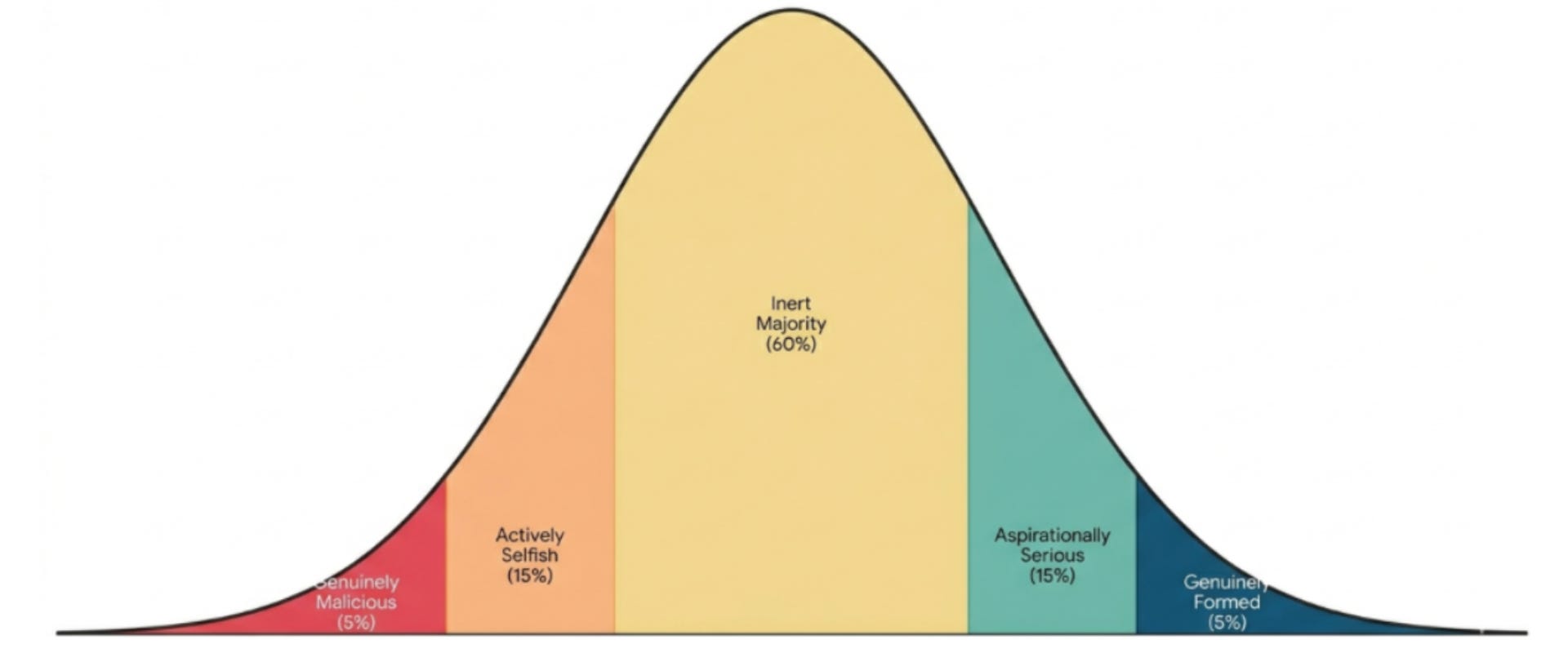
Approximately five percent are Genuinely Malicious: those whose character is organized around the exploitation and abuse of others to maximize their own goods. They are not easy to identify early because the effective ones do not announce themselves. Clinical research on dark personality pathology places the prevalence of psychopathic traits among corporate managers at roughly four times the general population rate. In the environments where power is contested and consolidated, five percent is a floor.
Approximately fifteen percent are Actively Selfish. They have made a largely conscious decision that life is a competition they intend to win, and have placed their considerable capacity for moral reasoning entirely in service of self-interest. The tell is what happens when holding a principle becomes expensive. They will not hold it.
Approximately sixty percent of the people in your life fall into what the framework calls the Inert Majority. They are not bad so much as unformed, people who have absorbed the ambient values of their environment without having examined or chosen them, and who defend those values under challenge without understanding that the defense is structural rather than considered. The drivers for their decisions will vary and be weighted based on what each individual values from highest to lowest, be it peer pressure and relational status, power and wealth, parental or familial expectation, or other factors. But every factor for the Inert is external in nature. These people are not enemies. They are not allies. They are the weather.
Approximately fifteen percent are Aspirationally Serious. They have looked at the unreflective life and found it insufficient. They are working, with varying degrees of consistency and self-knowledge, against their own defaults. They fail. They rationalize sometimes. But the orientation is genuine, and a genuine orientation in a landscape this flat is the beginning of a different kind of life.
Approximately five percent are Genuinely Formed. These people are rare. You may go years without encountering someone who genuinely belongs here. The loneliness of serious formation creates pressure to promote people to this tier earlier than advisable, before the evidence is sufficient. Resist that promotion. Especially with yourself.
Each of these types warrants a different posture from you. Decency is extended to all five. Trust is earned by the fourth and fifth. Access is conditional to the fourth, and guaranteed to the fifth, and then only after it has been demonstrated rather than assumed.
• • •
The Cost of Misclassification
Every consequential failure in this domain traces back to placing someone in the wrong category: the Inert person idealized past their actual level, the Actively Selfish extended relationship terms they were never capable of honoring, the Genuinely Malicious seek and often gain access under a charming guise that perfectly mimics integrity and virtue.
What makes the last category so costly is not the harm itself, which is recoverable. It is the epistemological damage. When someone who presented as trustworthy reveals themselves as predatory, the instrument you used to judge trustworthiness is called into grave doubt. This is the deepest wound the Genuinely Malicious inflicts: not the specific injury, but the doubt about your own capacity to see friend from foe. That doubt, left unnamed and unprocessed, becomes the mechanism by which a man closes himself permanently.
Accurate classification makes warmth possible, by ensuring that it is extended toward those equipped to receive it and protected from those who would abuse it. Trust extended to the Genuinely Formed means something because it was withheld from everyone who had not yet earned it.
One hazard of the framework must be named directly. If eighty percent of the people a man encounters are unformed, strategically selfish, or predatory, the temptation is to withdraw into a defensive crouch, treating every interaction as a threat assessment and every relationship as a risk to be minimized. The framework is a tool of discernment, not a license for isolation. Civil, pleasant engagement with the Inert Majority is not a compromise. It is the ordinary texture of a complete life within a society. The man who frames discernment as isolation has not applied the framework. He has misunderstood it.
Accuracy is the only foundation on which genuine relationship can be built. The framework exists to produce accuracy. What it does not produce is coldness, because the man who sees clearly still extends decency to everyone, still engages the Inert with patience, still transacts with the Selfish cautiously where transaction serves him or is unavoidable. What it removes is the confusion that makes him vulnerable to the wrong people.
• • •
What This Series Covers
Each of the next five installments examines one tier in detail: what the type looks like, what specific danger it presents, and what the correct terms of engagement are. Posts seven through thirteen apply the framework to the domains where the classification problem is most acute: the emotional register of the formed man, the current dating strike of young people, vocational fit, friendship, and the structural loneliness that accompanies serious formation over time.
The distributions assigned to each tier are grounded in fifty years of moral development research, clinical prevalence data on dark personality pathology, and observational work on moral exemplars under cost. Each installment in this series will carry the empirical basis for the tier it covers, in terms of what the research actually shows, where it is strong, and where honest estimation fills the gaps the data cannot close. Readers who want the full accounting before the series is complete will find it in the Appendix post, which collates the evidence for all five tiers in one place.
Post Two covers the Genuinely Malicious.
• • •
The posts in this series originate in research performed for, but ultimately excluded from, The Book of the Nobleman. Available at amazon.com/dp/B0H2D2ZCNY